Humbe’s Dueño del Cielo: The Sound of A Sky Across Borders
Humbe is hard to pin down—by design.
He sings about love and loss with orchestral weight, then disrupts that gravity with R&B. He shifts seamlessly between humor and vulnerability—making you laugh in conversation, then moving listeners to tears through his music. He wears a fur coat and headband like he stepped out of a fashion editorial, only to blush when fans call him “guapo.” Young, but emotionally precise. Soft, but intentional. Poised, yet deeply personal.
That range was on full display in Brooklyn, during an intimate, free listening session for Dueño del Cielo at National Sawdust. The venue—known for championing experimentation and access—filled with a mostly young, Spanish-speaking crowd, some of whom had traveled across state lines for a brief, shared exchange.
When Humbe took the stage, he carried both cinematic presence and an unguarded ease. The room responded immediately. That contrast — between poise and openness — would become a quiet throughline of the evening.
Near the end of the night, he paused to thank the room. With the same candor that has quietly become part of his appeal, he admitted he hadn’t known what to expect walking into the evening. He was grateful people showed up. He wasn’t sure they would.
Less than ten days later, Humbe’s first-ever New York headlining show sold out during a short pre-sale. Los Angeles followed, with additional dates added before tickets even reached general sale. For an artist whose career has largely unfolded in Mexico, the moment signaled a meaningful shift—one defined as much by resonance as by scale.
A Trilogy, a Timeline, a Mirror
Dueño del Cielo completes a creative trilogy that began with Esencia and unraveled through Armagedón. But while the album marks a new chapter, its reception in the U.S. reflects a connection that’s been building for years—one that followed the singer-songwriter from digital spaces into physical rooms.
At the Brooklyn session, he described the trilogy almost mythologically.
Esencia, a pristine world destroyed by Armagedón. Dueño del Cielo is what comes after.
“From the ashes,” he said, “there is still hope. There is still faith. There is still reconstruction.”
At a moment when Latinos navigate transition, uncertainty, and emotional fatigue, the album resonates from within a shared emotional landscape.
An Album Shaped by Change
At its core, Dueño del Cielo is an album about transformation. Humbe described it as a meditation on change—not as something to fear, but as something inevitable and even necessary.
“One of the most important things this album taught me,” he said, “is that change is one of the most beautiful things life gives you.”
He spoke plainly about how, in earlier projects, he tried to hold onto a fixed version of himself. That resistance, he admitted, became its own source of frustration.
“Accepting change is important,” he said. “It’s one of the purest messages on Dueño del Cielo.”
That philosophy shapes the album sonically and thematically. Written in isolation during an extended creative retreat in Iceland with his brother Emiliano—his longtime collaborator and manager—the 22-track record moves fluidly across genres, from pop and R&B to mariachi, orchestral arrangements, and softer experimental moments. The experimentation is deliberate, but it never feels scattered.
“Fantasmas” and Learning How to Grieve
One song, in particular, has followed Humbe across borders: “Fantasmas.” But the song’s meaning runs deeper than its virality.
“‘Fantasmas’ helped me see death in a more celebratory way,” he said. “It helped me commemorate instead of remembering only through sadness.”
That perspective is central to the album’s structure. Dueño del Cielo is not an exercise in lingering inside loss, but in moving through it—allowing grief to coexist with renewal.
Across social media, “Fantasmas” took on a parallel life, surfacing in videos that capture separation, displacement, and forced goodbyes. The song holds those moments, offering an emotional language that feels intimate and collective.
Its placement near the end of the album reinforces the project’s philosophy, which Humbe likened to a kind of rebirth—one in which faith, reconstruction, and hope still emerge from the ashes.
“Even when the world feels broken,” Humbe said, “you can always look up at the sky and find hope.”
The sky, in Dueño del Cielo, becomes something simple and shared—untouchable, constant, available to anyone who needs it.
Why It’s Resonating Now
Humbe’s U.S. audience spans generations and backgrounds—Spanish-dominant listeners, bilingual fans, and others for whom Spanish is something inherited rather than primary. What connects them isn’t fluency, but feeling.
The chemistry is as much about bearing as it is about sound. Humbe is, at once, a Vogue-cover figure and someone unapologetically tender. That duality surfaces in the closing seconds of Morfina, when a raw voice note from his father cuts in. He recounts small rituals—picking up barbacoa after work, listening to his tracks every day—and closes with a simple “Te amo, chaparro.” It’s an intimacy familiar to Latino families shaped by distance, time zones, and lives in motion.
During the Brooklyn session, Humbe spoke openly about the importance of family support in an industry he described, bluntly, as “muy jodida.” He expressed gratitude for having his brother beside him and for the grounding presence of his parents.
That grounding is audible throughout Dueño del Cielo, an album rooted in grief but oriented toward rebuilding. While the arc may be personal, it feels familiar to a generation of the diaspora shaped by loss and reinvention— leaving things behind, rebuilding identities, carrying multiple versions of themselves at once.
A Quiet Breakthrough
Humbe’s U.S. tour may look like expansion on paper. But what’s happening feels quieter — and deeper. After years of building a community that began online—particularly through TikTok—his music is finding bodies, rooms, and voices across borders.
As the album continues to unfold across stages in Mexico and the U.S., Dueño del Cielo feels less like an album release. It is a reflection of a shared emotional moment—one in which music becomes a place to stand, breathe, and look up.
This piece is part of Field Notes: 24 Hours of Brooklyn, an ongoing editorial series from Moved by Art documenting artists, makers, and spaces that change us.
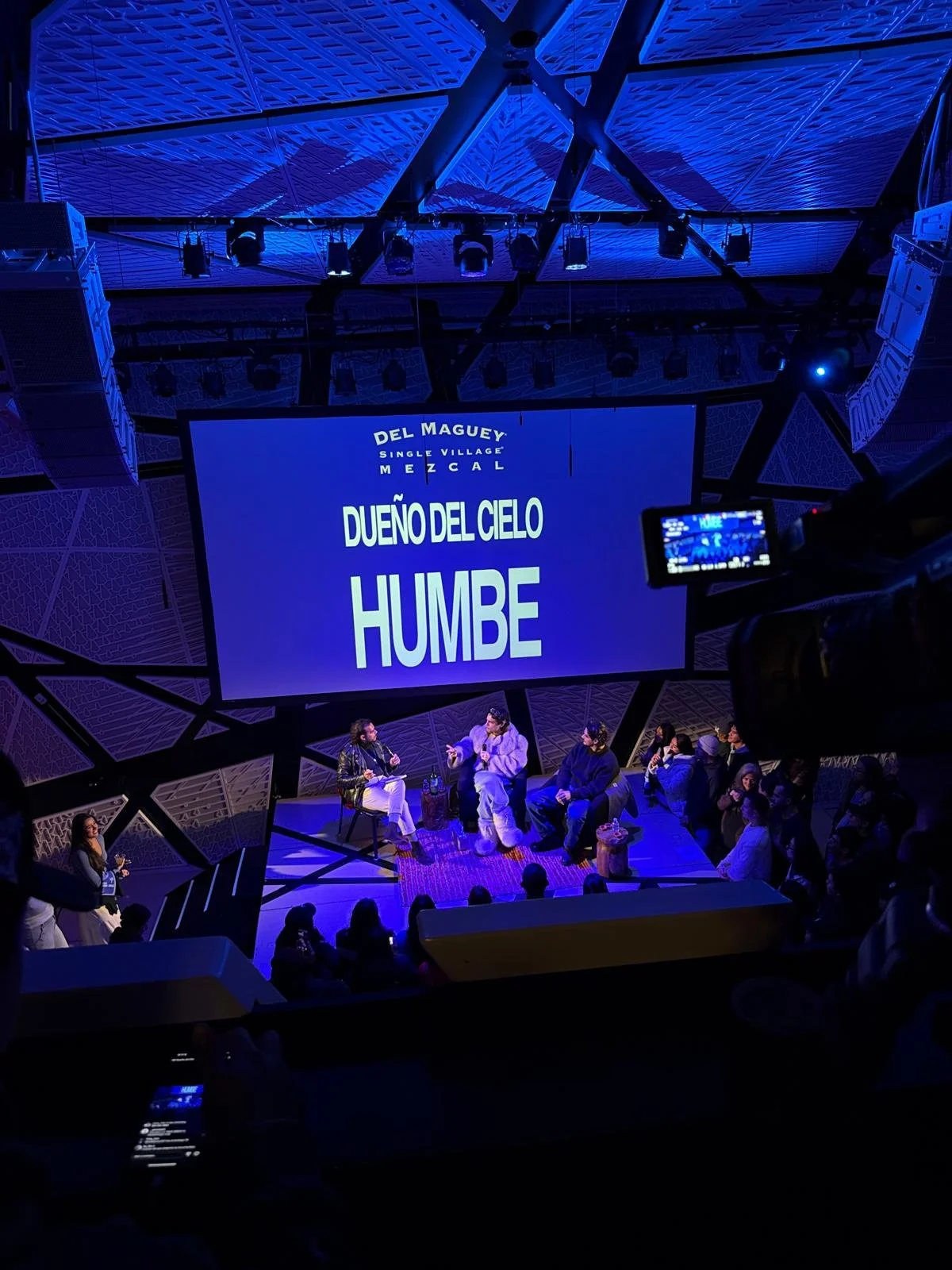
Under blue light, opening remarks from Humbe and his brother and manager, Emiliano Rodriguez.
The room erupts as Humbe and Emiliano take the stage at National Sawdust.
Reflecting on change, Humbe moves between insight and humor.
50mm fills the room as Humbe and Emiliano sign autographs.
The night closes with Fantasmas, selfies, and more autographs.